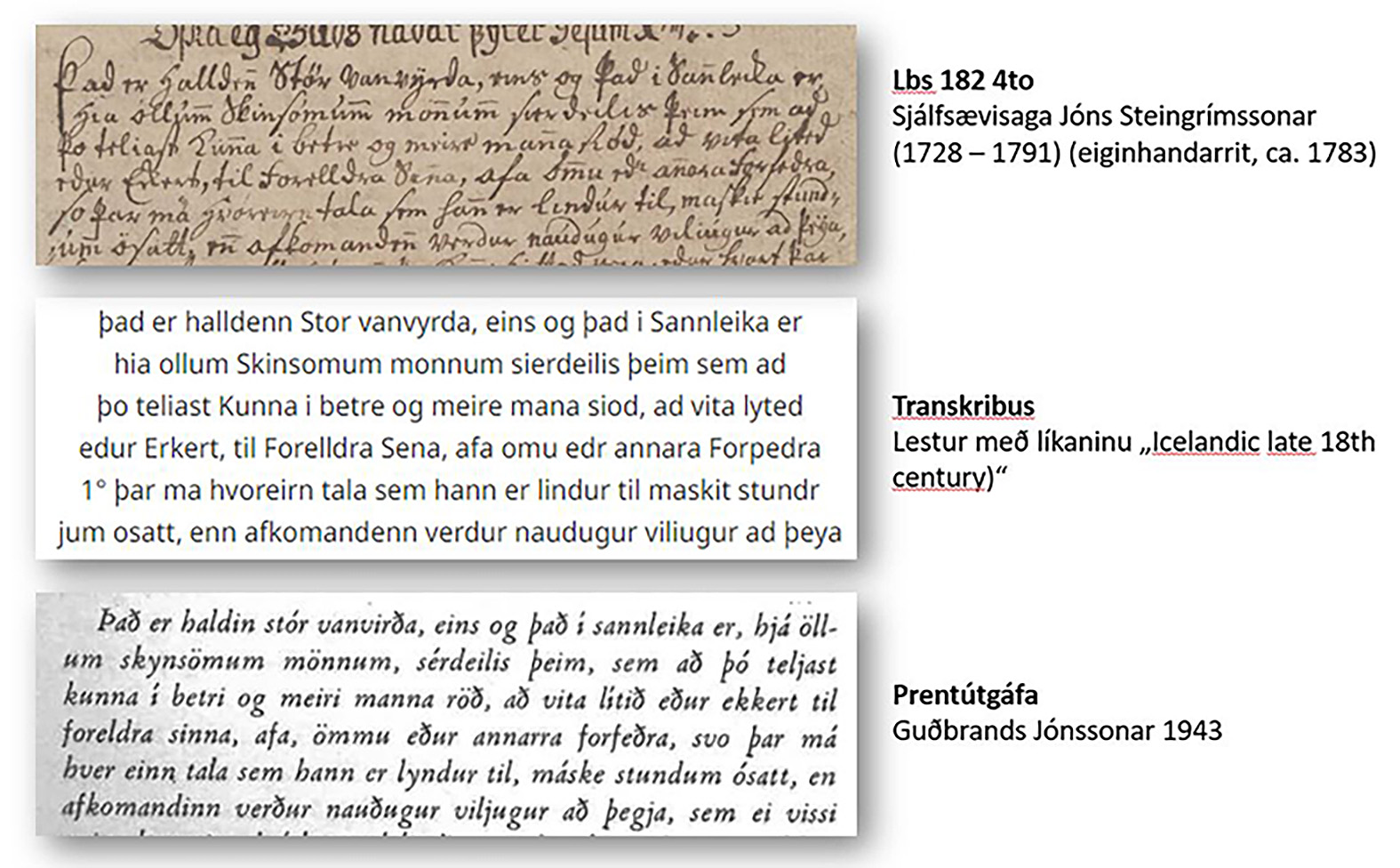
In recent years, there have been significant advances in the field of artificial intelligence. One manifestation of this development is the digital reading of manuscripts and documents. One example is the Austrian program Transkribus, which can be traced back to the European projects TranScriptorium from 2013-2015 and READ from 2016-2019. The program can read handwritten text and produce a digital transcription of it. It relies on models that have been trained to read different types of writing from different times and different regions.
In 2022, the Center for Digital Humanities and Arts (MSHL) received a grant from the RANNÍS Infrastructure Fund to create models for Icelandic script, and historian Emil Gunnlaugsson was hired to carry out the project in collaboration with the National Archives of Iceland and the National Library of Iceland – University Library. The result was two models: one that can be used to read Icelandic manuscripts from the second half of the eighteenth century, and the second for Icelandic manuscripts from the mid-nineteenth century. Emil uploaded a considerable amount of images of Icelandic documents and manuscripts from the National Archives of Iceland and the manuscript collection of the National Library of Iceland – University Library, had the program read the text and corrected errors. The program can now read text from this period with quite good success, or at least make it easier for readers to read.
The program is available at www.transkribus.eu where users can register and receive 500 pages of free credit, upload images of manuscripts and documents (e.g. from handrit.is, skjalasafn.is or use their own images) and have the program read illegible text to them. This new technology is completely changing access to Icelandic cultural heritage.